Fat and Refined Carbohydrates – Why So Dangerous?

The body converts food fat into body fat quickly and easily: 100 calories of ingested fat can be converted to 97 calories of body fat by burning a measly 3 calories. Fat is an appetite stimulant: the more you eat, the more you want . If a food could be scientifically engineered to create an obese society, it would have fat, such as butter, mixed with sugar and flour.
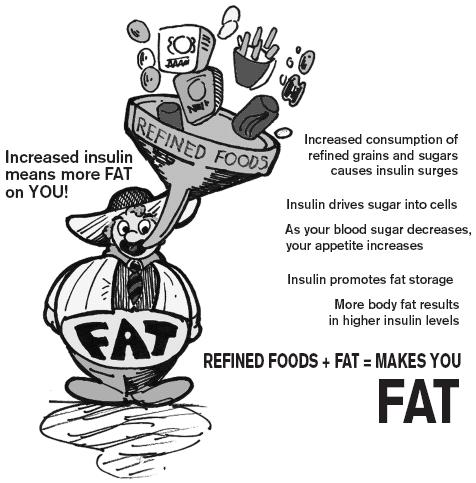
The combination of fat and refined carbohydrates has an extremely powerful effect on driving the signals that promote fat accumulation on the body. Refined foods cause a swift and excessive rise in blood sugar, which in turn triggers insulin surges to drive the sugar out of the blood and into our cells. Unfortunately, insulin also promotes the storage of fat on the body and encourages your fat cells to swell.
As more fat is packed away on the body, it interferes with insulin uptake into our muscle tissues. Our pancreas then senses that the glucose level in the bloodstream is still too high and pumps out even more insulin. A little extra fat around our midsection results in so much interference with insulin’s effectiveness that two to five times as much insulin may be secreted in an overweight person than in a thin person. The higher level of insulin in turn promotes more efficient conversion of our caloric intake into body fat, and this vicious cycle continues. People get heavier and heavier as time goes on.
Eating refined carbohydrates, as opposed to complex carbohydrates in their natural state, causes the body’s “set point” for body weight to increase. Your “set point” is the weight the body tries to maintain through the brain’s control of hormonal messengers. When you eat refined fats (oils) or refined carbohydrates such as white flour and sugar, the fat-storing hormones are produced in excess, raising the set point. To further compound the problem, because so much of the vitamin and mineral content of these foods has been lost during processing, you naturally crave more food to make up for the missing nutrients.
Our Oil-Rich Country, or From Your Lips Right to Your Hips.
An effective way to sabotage your weight-loss goals is with high-fat dressings and sauces. Americans consume 60 grams of added fat in the form of oils, which is over five hundred calories a day from this form of no-fibre, empty calories. Refined or extracted oils, including olive oil, are rich in calories and low in nutrients.
Oils are 100 percent fat. Like all other types of fat, they contain nine calories per gram, compared with four calories per gram for carbohydrates. There are lots of calories in just a little bit of oil. Fat, such as olive oil, can be stored on your body within minutes, without costing the body any caloric price; it is just packed away (unchanged) on your hips and waist. If we biopsied your waist fat and looked at it under an electron microscope, we could actually see where the fat came from. It is stored there as pig fat, dairy fat, and olive oil fat —just as it was in the original food. It goes straight from your lips right to your hips! Actually, more fat from your last meal is deposited around your waist than on your hips, for both men and women. Analysing these body-fat deposits is an accurate way for research scientists to discern food intake over time. Having research subjects remember what they ate (dietary recall analysis) is not as accurate as a tissue biopsy, which reports exactly what was really eaten.
Foods cooked in oil or coated with oils soak up more oil than you think. A low-calorie “healthy” food easily becomes fattening. Most Americans eat negligible amounts of salad vegetables, but when they do eat a small salad, they consume about three leaves of iceberg lettuce in a small bowl and then proceed to pour three or four tablespoons of oily dressing on top. Since oil is about 120 calories per tablespoon, they consume some 400 (empty) calories from dressing and about 18 from lettuce. They might as well forget the lettuce and just drink the dressing straight from the bottle. One key to your success is to make healthful salad dressings that are low in fat and calories. Some commercial dressings are available with less then twenty calories per tablespoon.

The message Americans are hearing today from the media and health professionals is that you don’t need to go on a low-fat diet, you merely need to replace the bad fats (saturated fats mostly from animal products and transfats in processed foods) with olive oil. Americans are still confused and receive conflicting and incorrect messages. Olive oil and other salad and cooking oils are not health foods and are certainly not diet foods.
There is considerable evidence to suggest that consuming mono – unsaturated fats such as olive oil is less destructive to your health than the dangerous saturated and trans fats. But a lower-fat diet could be more dangerous than one with a higher level of fat if the lower-fat diet had more saturated and trans fats.
In the 1950s people living in the Mediterranean, especially on the island of Crete, were lean and virtually free of heart disease. Yet over 40 percent of their caloric intake came from fat, primarily olive oil. If we look at the diet they consumed back then, we note that the Cretans ate mostly fruits, vegetables, beans, and some fish. Saturated fat was less than 6 percent of their total fat intake. True, they ate lots of olive oil, but the rest of their diet was exceptionally healthy. They also worked hard in the fields, walking about nine miles a day, often pushing a plough or working other manual farm equipment.
Americans didn’t take home the message to eat loads of vegetables, beans, and fruits and do lots of exercise; they just accepted that olive oil is a health food. Today the people of Crete are fat, just like us. They’re still eating a lot of olive oil, but their consumption of fruits, vegetables, and beans is down . Meat, cheese, and fish are their new staples, and their physical activity level has plummeted. Today, heart disease has skyrocketed and more than half the population of both adults and children in Crete is overweight.
Even two of the most enthusiastic proponents of the Mediterranean diet, epidemiologist Martin Katan of the Wageningan Agricultural University in the Netherlands and Walter Willett of the Harvard School of Public Health, concede that the Mediterranean diet is viable only for people who are close to their ideal weight. That excludes the majority of Americans. How can a diet revolving around a fattening, nutrient-deficient food like oil be healthy ? Ounce for ounce, olive oil is one of the most fattening, calorically dense foods on the planet; it packs even more calories per pound than butter (butter: 3,200 calories; olive oil: 4,020).
The bottom line is that oil will add fat to our already plump waist lines, heightening the risk of disease, including diabetes and heart attacks. Olive oil contains 14 percent saturated fat, so you increase the amount of artery-clogging saturated fat as you consume more of it. Consuming more fattening olive oil in your diet will raise your LDL (bad) cholesterol, not lower it. Weight gain raises your cholesterol; unprocessed foods such as nuts, seeds, and vegetables, utilized as a source of fat and calories instead of oil, contain phytosterols and other natural substances that lower cholesterol. Also, keep in mind that in Italy, where they consume all that supposedly healthy olive oil, people have twice the chance of getting breast cancer as in Japan, where they have a significantly lower fat intake.
The Mediterranean Diet looked better than ours because of the increased consumption of vegetation, not because of the oil. People who use olive oil generally put it on vegetables such as salads and tomatoes, so its use is correlated with higher consumption of produce. Their diets were better, in spite of the oil consumption, not because of it. If you are thin and exercise a lot, one tablespoon of olive oil a day is no big deal, but the best choice for most overweight Americans is no oil at all.